Tuesday, 19 May 2015

Pictures Taken at Right Moment

Pictures Taken at Right Moment :

We are huge fans of perfectly timed photos that capture perfect (and usually funny or unexpected) moments that come and go with a blink of the eye. The internet is abound with images shared by people who have captured images at just the right moment or from just the right perspective, so we wanted to share some more of them with you.
Anyone with a smart phone, point-and-click camera, DSLR or any other sort of camera can potentially capture such a moment – whether it’s staged or spontaneous. 
Source: reddit (h/t: distractify)
Source: imgur
Source: reddit (h/t: distractify)
Source: reddit
Image credits: Vladimir Levin
Source: reddit (h/t: distractify)
Image credits: Tom Baum
Source: imgur
Source: reddit 
Source: reddit
Source: reddit (h/t: distractify)
Source: imgur
Source: imgur 
Source: reddit
Source: reddit
Image credits: Nick Kelly
Source: unknown 
Image credits: troyANDabed
Source: reddit
Source: unknown 
Source: reddit
Source: imgur 
Source: reddit
Source: imgur
Source: imgur
Source: buzzland.com (h/t: buzzfeed)
Source: reddit

Saturday, 16 May 2015

Top 10 Most Beautiful Waterfalls in the World

Top 10 Most Beautiful Waterfalls in the World

Waterfalls are definitely the natural wonders on Earth. Visiting some of these waterfalls below might be a breathtaking experience, since they overwhelm with the stunning sight, as well as a splitting voice.

#1 Victoria Falls in Zimbabve

The Victoria Falls or Mosi-oa-Tunya is a gorgeous waterfall, located on the Zambia and Zimbabwe border. The water of Zambezi river falls down in a straight line for 354 ft (108 m). It is wide ( 5,604 ft/1,708 m), therefore water spray raises very high and can be spotted from many kilometers away.

#2 Iguazu Falls in Argentina

Iguazu Falls are found on the border of Brazil and Argentina. Not very high (285 ft/87 m), but very impressive: it has 275 cascades, that form a horseshoe and stretch for 8858ft (2700 m).

#3 Angel Falls in Venezuela

Angel Falls is the highest in the world, which falls down uninterrupted for 3,212 ft (979 m). You can visit it in Canaima National Park, which is protected by UNESCO. It is named after its discoverer US aviator Jimmie Angel.

#4 Kaieteur Falls in Guyana

Kaieteur Falls is found in Guyana. Water falls for 741 ft (226 m), then it reaches the first of the many steep cascades. It attracts many tourists, who like extreme trips, since the fall is in the middle of a wilderness with no urban amenities.

#5 Niagara Falls in USA/Canada

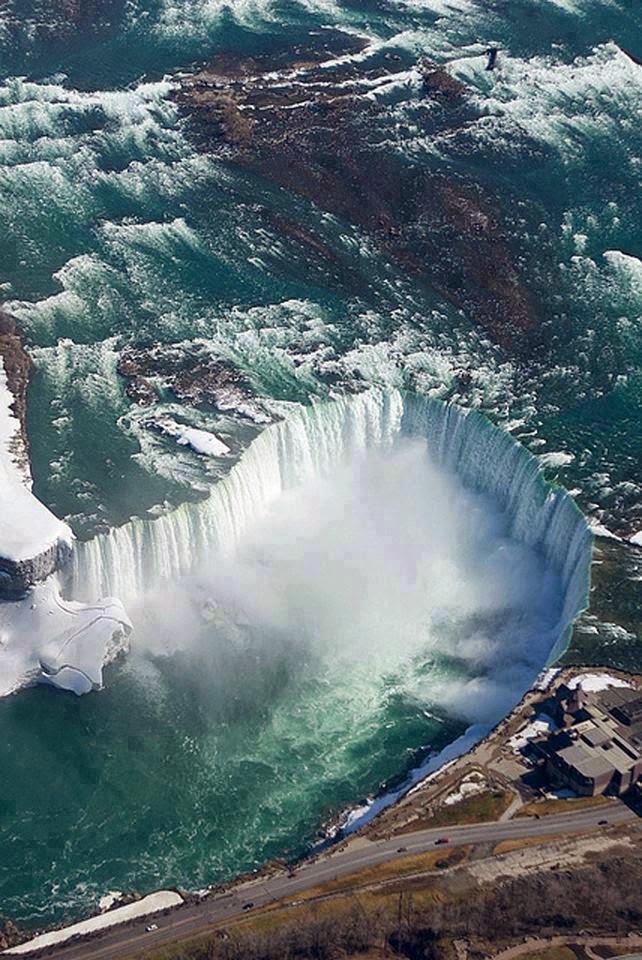
Niagara Falls is probably the most famous in the world. It marks US and Canada border. Niagara is formed of two sections – the Horseshoe Falls on the Canadian side and the American Falls on the American side – that are separated by an island. The Horseshoe Falls are more impressive: water here drops 173 ft (53 m), while the American Falls drop only 70–100 ft (21–30 m).

#6 Gullfoss (Golden Falls) in Iceland

Gullfoss is a magnificent waterfall located in southwest Iceland. Not particularly high (two 36 ft/11 m and 68 ft/21 m plunges), however, it is very beautiful. Due to a crevice, the river Hvítá seems to disappear into the abyss.

#7 Plitvice Falls in Croatia

Plitvice Falls are found in Plitvice Lakes National Park, Croatia. They are not very high falls, but are stunning due to the many cascades water has to overcome. There are hundreds of waterfalls. The color of water varies from from crystal clear to azure, to turquoise.

#8 Yosemite Falls in USA

Yosemite Falls is the highest waterfall in North America. It drops 2,425 ft (739 m) in the Sierra Nevada, California. The source of water is melting snow, therefore sometimes the stream may cease due to a little amount of snow.

#9 Sutherland Falls in New Zealand

Sutherland Falls are located in Fiordland, New Zealand. With its 1902 ft (580 m) plunge it is one of the tallest waterfall in the world. It falls in three cascades, that create this unique landscape. It was named after its discoverer Donald Sutherland in 1880.

#10  Nohkalikai Falls in India

Nohkalikai Falls is found in India. Water falls down for 1100 ft (335 m). Although the feeding stream is only 1,5 mi (2 km) long, Nohkalikai is still very impressive. A pool is formed below the fall, in which water receives green color.

Wednesday, 13 May 2015

Just Look at the Stunning Detail in These Mini Paintings and Try to Not Be Impressed

Just Look at the Stunning Detail in These Mini Paintings and Try to Not Be Impressed

Cape Town-based artist Lorraine Loots took up a remarkable 365-day challenge: to create a miniature painting every single day for an entire year. The artist began her challenge in the beginning of 2013 and, after enjoying the routine of her successful challenge, she decided to continue with the “Postcards for Ants" project in 2014.
The young artist has dedicated this year’s works exclusively to Cape Town, which happens to be the official World Design Capital of 2014. Fans of Loots’s work can write to the artist and book up-coming paintings or prints, or suggest Cape Town-themed ideas or places for her to paint.
More info:  lorraineloots.com | Tumblr | Instagram | Facebook (h/t: lustikfontanel)

Loots’ work is inspired by animals, nature, books and food.

Just Look at the Stunning Detail in These Mini Paintings and Try to Not Be Impressed

Just Look at the Stunning Detail in These Mini Paintings and Try to Not Be Impressed

Just Look at the Stunning Detail in These Mini Paintings and Try to Not Be Impressed

She plans to create 100 mini paintings in 2015.

Just Look at the Stunning Detail in These Mini Paintings and Try to Not Be Impressed

Just Look at the Stunning Detail in These Mini Paintings and Try to Not Be Impressed

Just Look at the Stunning Detail in These Mini Paintings and Try to Not Be Impressed

Saturday, 9 May 2015

7 Conversational Tricks to Appear More Confident

7 Conversational Tricks to Appear More Confident

Confidence can carry you through a lot in life. It can help you perform better in job interviews, appear more authoritative when addressing a crowd, and land more deals and partnerships in your business. Unfortunately, most of us don't feel confident 100 percent of the time, and when we do feel confident it doesn't always project outwarding ways that enable us to succeed.
During the course of conversation, there are several tricks you can use to make your words sound more authoritative, and to address your audience with greater overall confidence. Here are seven of them.

1. Speak more slowly.

Some of us speak faster when we're nervous. Some of us are naturally fast talkers. Regardless of your motivations, conscious or subconscious, speaking too quickly indicates a lack of authority or a lack of confidence. In addition, while speaking quickly, you're more likely to make mistakes in your enunciation, and you have less time to think through your words. Focus on speaking more slowly in your conversation, allowing your words to draw out and giving your sentences a weightier rhythm. Your audience will have more time to digest the words you're speaking, and you'll be less likely to make any critical errors that compromise your speaking integrity.

2. Use pauses to your advantage.

Using pauses is another strategy that can help you speak slower, but it's effective in its own right. Work on creatively using pauses to give more impact to your speaking. For example, if you have an opening for a public presentation that's eight sentences long and you make a significant point after sentence three, throw in a sizable seconds-long pause. It will add more weight to whatever your last sentence was and give you audience time to soak it in. It also gives you a chance to collect your thoughts and prepare for the next section of your speech, adding to the total amount of authority and confidence you project.

3. Avoid asides.

In a scenario that allows for preparation, such as giving a speech to a public audience, asides are fine. You have advance time to prepare them, determine if they're relevant, and include them if they are. In more natural conversations, however, improvised asides can be damaging. For example, if you're in a job interview and you answer a question directly, then spiral into a related story about something that happened to you a few years ago, it could be a sign that you're nervous and looking to fill conversational space. Instead, focus only on what's immediately relevant.

4. Lower your vocal range.

Take a look at some of the most famous speeches throughout history, at currently popular politicians, and even at local newscasters. You'll find that most of them have lower tones of voice, and this is no coincidence. People tend to view speakers with lower speaking voices as having more authority and confidence. As much as you can, practice speaking in a lower tone of voice. Don't force yourself or you'll sound unnatural, but if you can get yourself a tone or two lower, it can make a real difference.

5. Improve your posture.

Body language is just as important in conversation as the words that leave your mouth. Whether you're sitting or standing in front of your audience, work to improve your posture. Stand or sit up straight with your shoulders back, and keep your head held high. This will make you appear bigger and more confident, and will help you feel more confident as well. Plus, you'll get the added benefit of aligning your body so you can breathe--and therefore speak--more efficiently. Posture can demand a lot of work, so make sure to practice in advance.

6. Gesticulate.

Gesticulation--the practice of using your hands and arms to punctuate or enhance your verbal statements--is another valuable body language strategy. Speakers who use body language actively in their presentation tend to be viewed as more confident and more authoritative than those who do not. Obviously, different hand gestures can signal different things, and if you simply wave your hands wildly in front of your audience, it may make you come across as out of control. Instead, focus on reserving your hand gestures for your most impactful words, and try to keep your movements reserved and under strict control.

7. Talk more.

The conversations that matter in our lives--whether they're in the form of a public presentation or a business negotiation--are somewhat rare. But that doesn't mean we can't prepare for those meaningful conversations in our everyday lives. Seek out new opportunities to communicate with others whenever you get the chance, and in any context. Put these speaking strategies to practice and focus on improving your abilities over time. The only way to get better is to plunge in and keep working at it, so sign up to be a public speaker when you can and strike up conversations with strangers wherever you go.
The beauty of these conversational tricks is their sheer practicality; they can be used anywhere, in almost any context where you're speaking to one or more other people. Experiment with them by practicing on a friend or a colleague. Over time, they will become second nature to you, and your natural speaking voice will convey a greater overall level of confidence and authority.

Thursday, 7 May 2015

Warp Drive & Transporters: How 'Star Trek' Technology Works (Infographic)

Warp Drive & Transporters: How 'Star Trek' Technology Works (Infographic)


Infographic: Inside the fictional technology of "Star Trek"

The original "Star Trek" television series featured technology that had first appeared decades earlier in science fiction stories. Pulp heroes had been wielding ray guns, flying faster than light and teleporting from place to place since the 1930s. But perhaps the true inspiration of Star Trek’s superscience is the revolutionary physics discoveries of the early 20th century. Relativity, discovered by Albert Einstein and quantum physics, pioneered by Max Planck  revealed a universe far different than ordinary human experience might suggest.
Although Einstein’s theory forbids matter to accelerate past the speed of light, the demands of sci-fi storytelling require that people be able to travel between the stars in a reasonable amount of time, usually hours, or at most, days. Enter the space warp drive, or as it was called in "Star Trek’s" pilot episode, "hyperdrive."
Warp drive in Star Trek works by annihilating matter (in the form of deuterium, a kind of hydrogen gas) and antimatter in a fusion reaction mediated by dilithium crystals. This produces the enormous power required to warp space-time and drive the ship faster than light.


The crew of the Enterprise measures velocity in warp factors. Warp factor 8 equals the cube of 8 (8 times 8 times 8), or 512 times light speed.
Even this velocity is too slow to allow starships to travel as quickly as they appear to on TV. In reality, the script writers arbitrarily allowed the Enterprise to get to wherever it was going, as fast as was convenient for storytelling. By the era of "Star Trek: The Next Generation," the warp speed scale was recalibrated. Under the new scale, a starship could get from Earth to Alpha Centauri in about 37 hours at warp factor 8.

USS Enterprise Evolution in Photos (Gallery)

Science fiction author E.E. "Doc" Smith describes a spaceship traveling at a speed "thousands of times greater than that of light" in his novel "Skylark of Space," written between 1915 and 1921 and serialized in "Amazing Stories" magazine in 1928.
The technology and style of "Star Trek" was influenced by the 1955 film "Forbidden Planet." United Planets Cruiser C-57D (above) used its quanto-gravitic hyperdrive to greatly surpass the speed of light. The cruiser travels to the star Altair, 16.7 light-years from Earth, in 378 days.
In 1994, Miguel Alcubierre proposed moving not a spaceship, but space itself, faster than light. All that would be required is to distort the fabric of space-time into a bubble surrounding a spaceship. Enormous energy would be required, but once created, the bubble would move independently of the rest of the universe, even faster than light.
The bubble moves by compressing the space-time in front of it and expanding the space-time behind it.


NASA scientist Harold "Sunny" White believes as-yet-undiscovered "negative energy" could be used to create the space-warp bubble, using a smaller amount of total energy than Alcubierre thought possible.
A plausible alternative to traveling across space is the wormhole, a shortcut between two widely separated points in space-time. Scientists Albert Einstein and Nathan Rosen first proposed the wormhole, or "Einstein-Rosen Bridge," in 1935. Wormholes have not yet been observed in nature, but they are not forbidden by our current understanding of physics.
If they exist, wormholes would permit travel faster than light and backward through time (at least to the time when the wormhole was created).
In "Star Trek's" Transporter device, normal matter is converted temporarily into energy, then beamed to a target point for restoration to its original pattern and structure. The Transporter has a range of about 16,000 miles (25,750 kilometers).
The "Vibra-Transmitter" described in Frank K. Kelley’s 1933 story "Into the Meteorite Orbit" functions similarly to Star Trek’s Transporter. The human body is "reduced to vibration traveling on a wave-channel" and then reintegrated into matter in a receiving chamber.
In real-world science, subatomic particles can be quantum teleported, but this only transmits a quantum state between a pair of entangled particles, not the particles themselves. The human body contains an immense number of atoms, about 10^27 (one followed by 27 zeroes). Recording the quantum states of all these atoms would require an unrealistic amount of data storage. Even worse, quantum physics prevents the precise measurement of the individual atoms.
Deflector shields (or "screens") are an invisible force-field barrier activated automatically by the ship's computer when needed. Screens can be maintained continually for 20 hours before the ship’s power is exhausted. Transporters cannot be used when the screens are enveloping the ship.
Navigational deflector beams sweep the space ahead of the ship to shove aside obstacles such as small asteroids. Anything too large to be deflected triggers the ship’s computer to change course to avoid collision.
In earlier sci-fi, deflectors for diverting meteoroids out of a spaceship’s path show up in "The Ethical Equations” by Murray Leinster, published in "Astounding Science Fiction" in 1945. 
Lawrence Krauss, in his book "The Physics of Star Trek," supposes that to bend light (or phaser beams), deflector shields would have to warp space-time around the starship. But if warp drive is possible, deflector shields that work this way are perhaps also possible.
Tractor beams are a form of reverse deflector beam, pulling instead of pushing. The tractor beam has a range of about 100,000 miles (160,930 km).
E.E. "Doc" Smith uses the exact term "tractor beam" to describe force beams for grabbing objects in space in his 1931 story "Spacehounds of IPC," published in "Amazing Stories."
In real-world science, microscopic particles of matter have been manipulated in the laboratory with laser beams. Starships are much more massive. Tractor beams that work on an electromagnetic principle might be plausible in theory. However, Newton’s laws require that if the Enterprise pulls on another object with its tractor beam, the Enterprise itself will be moved toward the object. The Enterprise must fire thrusters to remain in place during the operation.
A phaser is an energy beam that can be "phased" to interfere with the wave pattern of any material object. Settings include dematerialize (converts matter to energy), disrupt (breaks down molecular cohesion), heat (increases molecular velocity) and stun (impacts the nervous system of a living target). Phasers can also be adjusted for use as cutting torch or welder.  A phaser set to overload creates a powerful explosion. The ship's main phaser batteries can destroy matter over vast distances and are powered directly by the warp engines. 
The Martian heat ray in H.G. Wells’ 1898 novel "The War of the Worlds" is very much like a ray gun or death beam. In the 1920s and 1930s, some scientists, including Nikola Tesla, believed that a death ray capable of killing at a distance was feasible. Toy Buck Rogers guns began appearing in the 1930s, one of which was called a “disintegrator pistol.”
Weapons exist today that are capable of stunning the human nervous system (the taser, for example). However, tasers require physical contact to deliver their charge. Due to the inverse square law by which energy decreases as distance increases, to disintegrate matter at a distance a phaser weapon would have to generate an incredible amount of energy. Military research continues into developing directed energy weapons capable of shooting down missiles.
A photon torpedo is an energy pod of matter and antimatter separated by a magno-photon force field. They can be fired directly as torpedoes, laid in a mine field or scattered in an enemy’s path like modern-day depth charges. Electrochemical, proximity and other fuses are available. 
Photon torpedoes require a quantity of antimatter. Generating even a few atoms of antimatter uses up an enormous amount of energy. The starship’s warp drive, powered by antimatter, also has this problem.

In theory, the explosive yield of one gram (0.04 ounces) of antimatter and an equal quantity of matter is about 43 kilotons (possibly lower in actual practice). Background material for the Next Generation series says that photon torpedoes carry 1.5 kilograms 3.3 pounds) of antimatter.